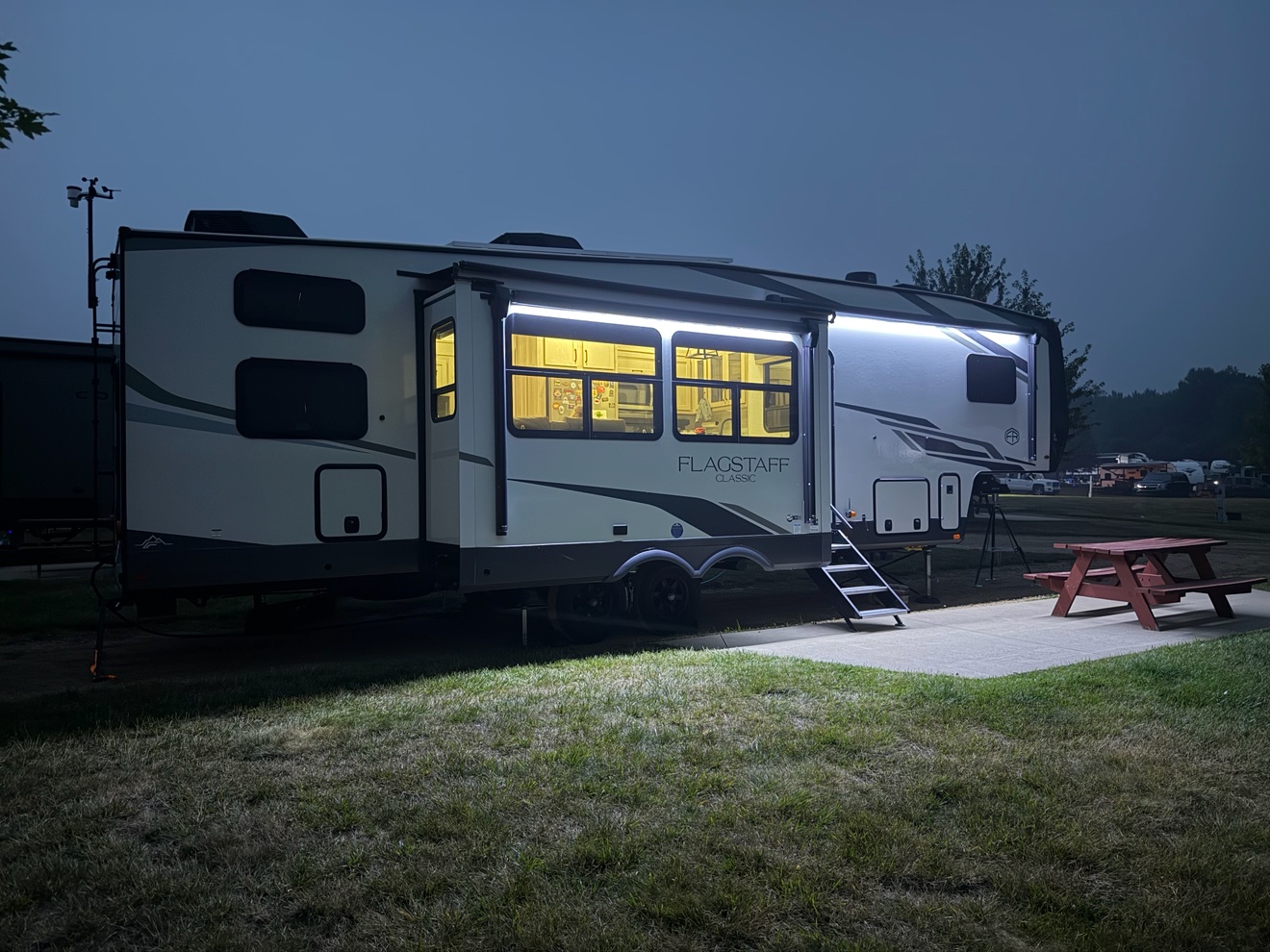
A weekend trip and a long stay are two different animals. On a weekend you can wing it. On a long stay, the stuff you didn’t plan for is the stuff that finds you — a fuel station you can’t fit into, a site that’s too small for your rig, a toll booth line that eats an hour of your day.
We’ve got a 9-day Christmas trip to Mississippi coming up in December and a 16-day run to Las Vegas in June, so this is how I get ready for a long one. None of this is complicated. It’s just the stuff that keeps a long trip from turning into a long headache.
Book ahead — but know the trade-off
Booking sites in advance can get controversial, and I get both sides of it. I’m personally the type of person that likes to have everything all planned out, from the gas stations I stop at to the campgrounds I stay at. For the most part, when I do an extended stay somewhere, I will book all my attractions and pay them off before the trip. That’s one less thing to worry about, especially when it comes to money.
Some people will say that booking sites in advance could end up screwing you over, especially if you have a detour or a breakdown. Breakdowns can cause you to show up late — a day or more late — to a campground. Some people will extend their stay at one campground, which would then throw off the other days at another campground, or campgrounds if you’re staying at multiple campgrounds.
Both sides are right. I still book ahead, because I’d rather have a site waiting for me than go hunting for one at the end of a long driving day. Just know the risk going in, and check the cancellation policy before you pay.
Plan your fuel stops before you need them
Planning your fuel stations in advance is a great way to make sure you go into a fuel station that you can actually fit into with your camper or RV. Most fuel stations you cannot get a 40-foot camper into, and you cannot fit a 13-foot-6 camper or RV under the awnings at the fuel station.
Planning your stops ahead of time will also help you budget your fuel costs, because you know where you’re stopping and roughly what you’re spending before you ever leave the driveway.
Book a site that actually fits your rig
Booking your campsites in advance is also a way to guarantee that you have a spot you can fit into, with the appropriate connections. Sometimes when you book on short notice, or the day of, you will get stuck with what they have. Before you know it, you’re trying to fit a 40-foot camper into a site that is made for something no bigger than 35 feet. You can sometimes get stuck with 30-amp only power when your camper or RV is 50-amp. Then you’re stuck using a dog bone adapter.
Here are the dog bone adapters that cover every combination. If you only buy one, get the one that matches your rig and the pedestals you run into most — but having the set means you’re never stuck:
- 30 amp to 50 amp adapter — plugs your 50-amp rig into a 30-amp pedestal
- 50 amp to 30 amp adapter cord — plugs your 30-amp rig into a 50-amp pedestal
- 30 amp to 15 amp adapter — compact plug adapter for a regular household outlet
- 50 amp to 15 amp adapter — plugs into a 50-amp outlet and gives you three household outlets
- 15 amp to 30 amp adapter cord — plugs your 30-amp rig into a household outlet
- 15 amp to 50 amp adapter cord — plugs your 50-amp rig into a household outlet
Whenever you do plug your camper in, even when you’re using a dog bone adapter, you still want to use an EMS surge protector. I personally have both a 30-amp and a 50-amp Watchdog EMS surge protector, and I don’t plug in without one. The 30-amp Power Watchdog and the 50-amp Power Watchdog both watch the power for you and shut it down if something’s wrong with the pedestal.
Carry a little water, not a lot
For longer trips, like Michigan to Florida, I will carry some fresh water in my tank. No more than 10 gallons. Remember, water equals more weight, which will hurt your fuel mileage, plus it adds weight to your weight limits. You want enough water that if you have to use the bathroom or make a snack, you can flush the toilet and wash your hands. That’s it. Fill up when you get there.
Pack for every kind of weather, but pack light
Packing can be tricky. Make sure you pack for any and all weather you are traveling through and to. Having a washer and dryer in the camper, or using the campground laundromat, is a great way to travel with less clothing, especially if you are camping for an extended period like two weeks or more. The more clothing you bring, the more weight that is — and weight is the enemy on a long trip.
Navigate like your rig depends on it — because it does
When traveling to new places, especially in different states that you are unfamiliar with, it’s a great idea to use an RV GPS like the Garmin RV GPS, a trucker’s GPS, or the RV LIFE app. These will make sure you do not go through any roads that your camper or RV will not fit through. Remember, the height is sometimes the one that gets most people. Also, if you’re traveling with propane — and 99% of campers and RVs do — some bridges and tunnels do not allow propane, and a regular GPS won’t tell you that.
Don’t stop for tolls if you don’t have to
One way to optimize traveling, besides planning your exact route and stops, is to have a toll transponder, or if your vehicle has the option, use the vehicle’s built-in toll pay. My Ram has Autokinex built in. They’re starting to put it on some vehicles, not only Rams. It keeps you rolling through the tolls, and it’s also cheaper to use a transponder than to pay for the toll on the spot or have them bill you.
Maintenance before you roll — and every night after
Before departure, make sure your camper or RV, and your vehicles — don’t forget generators too — are up to date on their maintenance. After every overnight stay, I will retorque the wheels. You will be surprised by how loose they become sometimes. Checking tire pressure is a good idea too, especially if you’re traveling from cold to warm or vice versa.
Don’t forget the animals
If you have animals, make sure you bring all their necessities, such as food, medicine, a brush and shampoo. Also, don’t forget their toys too. For me personally, my dog stays with my dad. That gives me more flexibility to drive longer and not have to worry about him when we go to the stores or to attractions for the day when we’re camping.
Set the house up before you leave it
Before you leave, like any time you leave your house for a period of time, make sure your house is set for your departure. Unplug any appliances that don’t need to be plugged in, like a countertop ice machine or a coffee maker. Surprisingly, this actually saves electricity — which is money — and reduces the risk of a fire.
If you’re traveling out of state, some banks, credit unions, and credit cards want to know, so they don’t suspect fraud on your account. Let them know before you go.
Letting family or close friends know of your travel is good practice, so if something does happen, they have an itinerary and know your whereabouts. Family or friends can also grab your mail, so your mail doesn’t get delayed, packages aren’t sitting on the porch, and your house won’t become a target for burglary. Robbers will watch houses — no cars and a full mailbox are indications no one is home.
Honestly, if you travel a lot, invest in some security cameras, or at minimum a camera doorbell like Wyze or Ring. A few worth a look:
- Wyze Wireless Duo Cam Doorbell — 2K HD, battery powered, comes with a Wi-Fi chime, two cameras so you can see people and packages
- Ring Wired Doorbell 4K Pro — Ring’s newest wired doorbell, 4K video
- Blink Doorbell and Outdoor Camera bundle — a 2K battery doorbell plus three outdoor cameras and a sync module, all in one box

A long stay is the best kind of camping there is — you actually get to settle in and enjoy the place instead of just passing through it. But it only works that way if the planning is done before you leave. Do the boring stuff at home, and the trip gets to be the fun part.
A quick note: some of the links in this post are affiliate links. If you buy through them, I earn a small commission at no extra cost to you. It helps keep the blog going, and I only link stuff I’d use myself.
What’s the one thing you always forget on a long trip? Let me know in the comments — I’m still building my own list.
If you like handmade camping and home decor, check out my Etsy shop, Outdooring — stained glass crosses and light-up glass blocks, all made to order.

Leave a Reply