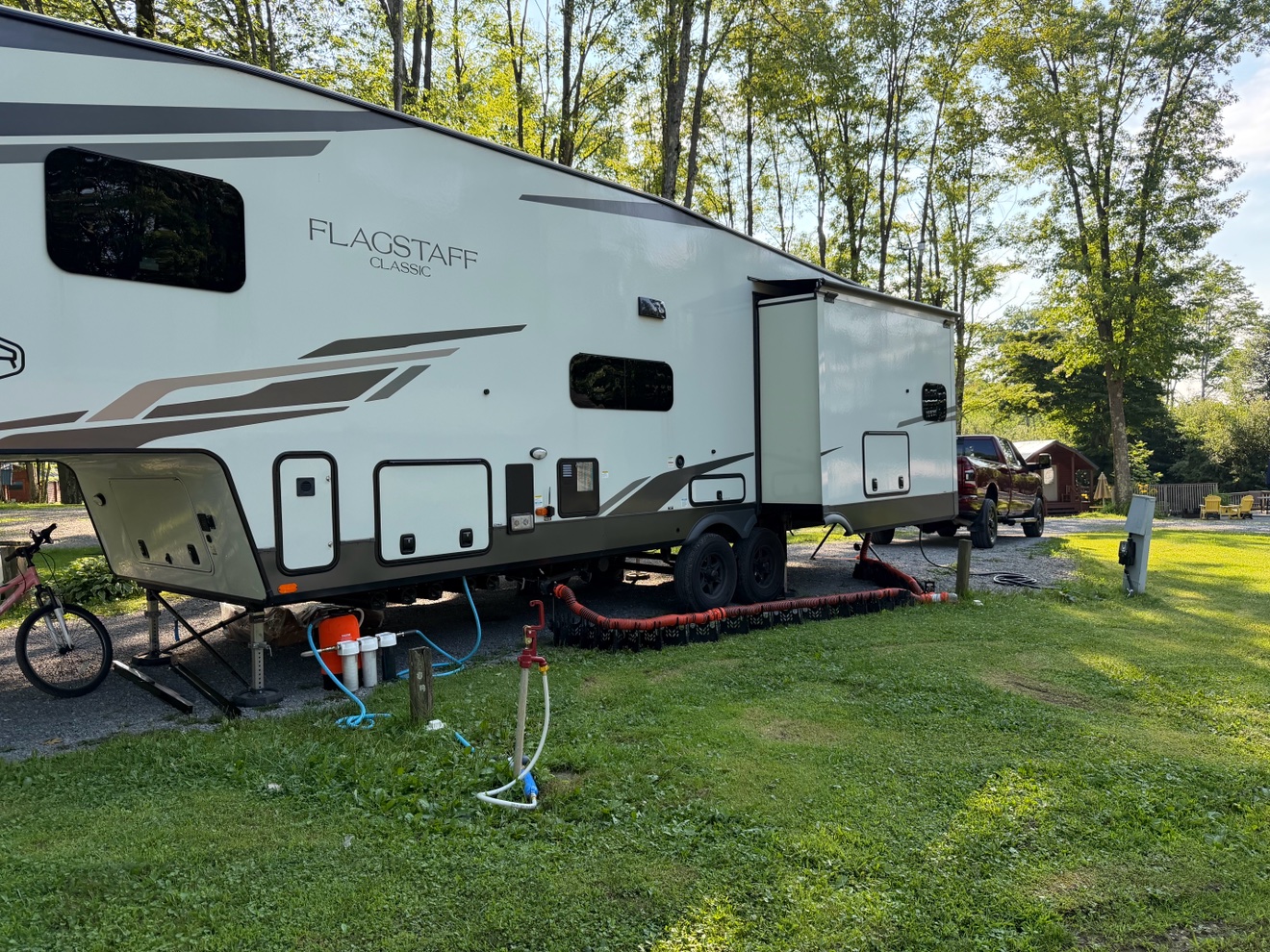
Campground water is unpredictable. One campground has good pressure, the next one barely trickles. One is on city water, the next is on a well. Some of it is clean, some of it is loaded with minerals, and some of it, well, you just don’t know what’s in it. I don’t trust any of it straight out of the spigot, so here’s how I run my water setup.
The setup, in order
It starts at the spigot with a cheap filter. I run a Camco blue 5-stage filter first, and then a pressure regulator. That order matters. The filter goes before the regulator on purpose, because sometimes a campground is on well water that’s high in minerals and especially iron. That stuff will beat up your pressure regulator, so the cheap filter takes the hit instead and protects it.
Campground water pressure is unpredictable too. Too much pressure going through your camper’s water system is a guarantee you’ll damage something. The regulator keeps it where it should be, and the gauge on it lets you see what pressure you’re actually getting.
Whether I run a water softener depends on if it’s well water or city water. Well water is usually the hard stuff with a lot of iron in it, and the softener cuts the iron down and makes the water not as hard, which protects your whole water system. But if you want to always play safe, you can run the softener even on city water. I do.
After the softener I run a 4-stage water filter system. That last filter pulls out some of the softener solution that’s left in the water, so what comes out the other end is as clean as I can get it before it goes into the camper.
What the filters don’t catch
Here’s the thing, though. Between the filters and the softener, all you’re really removing is minerals and metals. The part I’m personally always worried about is bacteria. One time my dog wouldn’t drink the water, and when Bear refused to drink it, that made me super nervous about drinking it myself. If the dog won’t touch it, I’m not drinking it either.
After that I bought a countertop reverse osmosis water filter with UV, the Ecoviva MATE4 UV. That sits inside the camper and it’s what we actually drink from. The reverse osmosis filters the water for real, and the UV light kills any bacteria in it. The TDS readout on it tells me the truth about the water coming out — if that number ever climbs, I know something’s wrong.
Why bother
Having suitable drinking water isn’t a luxury, it’s a necessity. And doing it this way means I’m not buying cases of plastic bottles every trip. Less waste, less money, and I know what’s in my glass.
One more thing that made the whole setup easier: quick connections. I put them on my water lines and filters, and hooking everything up is quicker now with no leaks. They’re a game changer, especially when you’re camping in the winter or you’ve had a long travel day and just want to get set up.
Winter camping
When you’re camping where temperatures can reach near or below freezing, you need a heated water hose. From the spigot I run the heated hose into the camper, and then from there it’s the Camco filter, then the pressure regulator, and then the 4-stage water filter system. Same idea, just protected from the cold.
That’s my whole water setup, spigot to glass. It takes a few extra minutes to hook up, but I’d rather spend the time on that than wonder what’s in my water.
What do you do for water at campgrounds — filter it, buy it, or just drink it straight from the spigot?
If you buy through the Amazon links in this post, I earn a small commission at no extra cost to you. It helps keep the blog going.
I make stained glass mosaics and light-up glass blocks over at my Etsy shop, Outdooring — check it out at outdooring.etsy.com.

Leave a Reply